Stories · The village
Everybody quotes it. Nobody can source it.
“It takes a village to raise a child.” Attributed to an African proverb, almost every time. When reporters went looking for which one, the trail went cold, and what they found instead was better.
Four words. Can you guess the common root? It is a common word :)
One root, commun, the Latin for shared. It runs through all four.
“It takes a village to raise a child.” You may have heard this idea credited to an African proverb. Which proverb is never specified, and it turns out that is not an oversight.
When reporters went looking for the source in 2016, they could not find one. Lawrence Mbogoni, who teaches African studies and grew up with precisely the practice the saying describes, called it “a reasonable and profound statement about collective social responsibility but perhaps not traceable to a specific origin.”
What the search did turn up is that the same idea appears in more than one language. In Jita, a Bantu language of northern Tanzania spoken along the shore of Lake Victoria: Omwana ni wa bhone, a child belongs to everybody. In Swahili, the lingua franca of East Africa: Asiyefunzwa na mamae hufunzwa na ulimwengu, whoever is not taught by their mother will be taught by the world.
So the famous line is not a quotation. It is a summary, and a summary of something more than one culture has already put into words.
The biology agrees. Humans are what anthropologists call cooperative breeders: unlike almost every other ape, we raise our young with substantial help from people who did not produce them. Among the Efe, hunter gatherers of the Ituri Forest in what is now the Democratic Republic of the Congo, Tronick, Morelli and Ivey found that babies are cared for by many people from the very start. Not because a mother is missing, but because that is simply how it is done.
And here is the part that matters for language. Romeo and colleagues recorded the ordinary conversation in 36 homes, then scanned the children, aged four to six, while they listened to stories. What predicted activity in Broca’s area, the part of the brain that builds language and speech, was not how many words the adults produced. It was how many times the conversation went back and forth between children and adults, a process known as conversational turns.
Not the volume. The turns.
A village is simply a community that helps produce turns by taking turns.
What this means at home
This is the rare finding that takes a little pressure off, and we felt it is important to start with. It is not about how much you say, or how many words are on the page. It is about leaving gaps and answering what comes back. So no, you do not have to narrate your day at your child like a sports commentator. And the grandparent, the neighbour, the childminder who chats with them is not competing with you for their attention. They are adding turns of their own.
Where Lex comes in
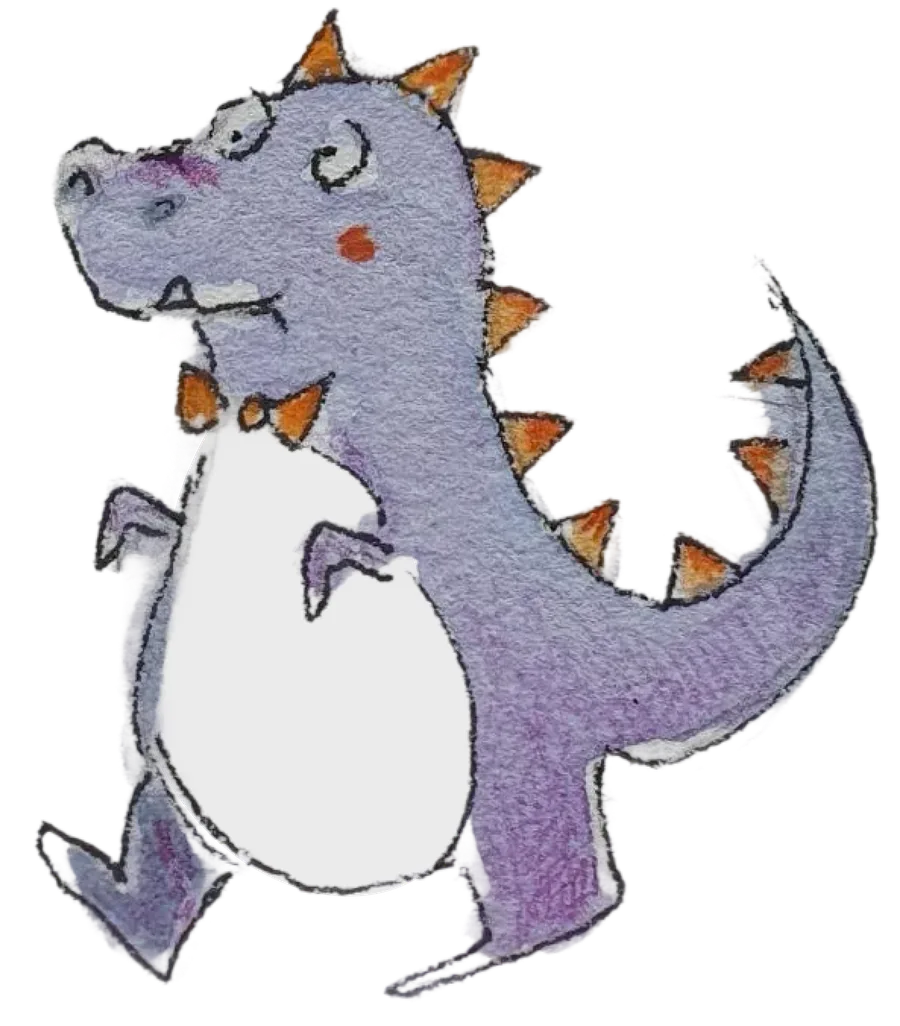
We help create some of those turns, by building the conversation into our books. In every Lex The Saurus book you will find what we call a call to action: a moment that invites the child to answer back.
We would recommend looking for books that do the same, whoever makes them. But if you like ours, we thank you for letting us, Locus Crocus, be part of your village.
Because it takes a village, and ours is called Locus Crocus.
Follow along.
New stories, works in progress, and the odd dad joke. We are on Instagram and Facebook.
References
- The proverb has no traceable source. Goldberg, J. (2016, July 30). It takes a village to determine the origins of an African proverb. NPR, Goats and Soda. npr.orgReporting, not peer reviewed research. The scholars consulted could not verify a single origin for the saying. The two proverbs quoted above were raised in that reporting. The phrase entered wide American use as the title of Hillary Clinton’s 1996 book.
- Humans raise children cooperatively. Hrdy, S. B. (2009). Mothers and Others: The Evolutionary Origins of Mutual Understanding. Belknap Press of Harvard University Press.The cooperative breeding account: alloparents, meaning carers who are not the genetic parents, are a standard and necessary feature of human child rearing rather than an exception. A book, not a journal paper.
- What that looks like in practice. Tronick, E. Z., Morelli, G. A., & Ivey, P. K. (1992). The Efe forager infant and toddler’s pattern of social relationships: Multiple and simultaneous. Developmental Psychology, 28(4), 568 to 577. doi.org/10.1037/0012-1649.28.4.568Efe infants and toddlers form multiple and simultaneous caregiving relationships from the first months, rather than starting with one person and widening later.
- Turns, not word count. Romeo, R. R., Leonard, J. A., Robinson, S. T., West, M. R., Mackey, A. P., Rowe, M. L., & Gabrieli, J. D. E. (2018). Beyond the 30 million word gap: Children’s conversational exposure is associated with language related brain function. Psychological Science, 29(5), 700 to 710. doi.org/10.1177/095679761774272536 socioeconomically diverse children aged 4 to 6. Home audio recordings plus fMRI during story listening. Conversational turns predicted left inferior frontal, Broca’s area, activation independently of socioeconomic status, IQ and adult word count alone. This is a correlation: it shows the link, not that adding turns causes the change.